
Every few months, another framework promises to explain the business. Find your moat. Obsess over the customer. Install an operating system. Build a brand. Productize the service. Delegate yourself out of the company. Move faster. Slow down and think.
Most of these ideas are useful. None is sufficient.
A framework is a lens. It clarifies one part of reality by simplifying the rest. That is exactly why frameworks help, and exactly why relying on one can become dangerous.
While building VMBARS, I kept running into questions that belonged to different disciplines. A strategy framework could help me think about durable advantage but say little about founder behavior. An operating framework could improve cadence while saying little about whether we were scaling the right thing. A sales framework could improve conversion while missing the fact that professional-services demand is built through trust, reputation, and readiness over time. And the work itself kept producing evidence that refused to stay in one box.
So instead of looking for one master playbook, I started building a latticework.
That became visible in practice. Work on an executive transition did not stop at a role description; it expanded into competency interviews, leadership-team design, onboarding and 100-day planning, and CEO scorecarding. A live selling problem became a reusable Diagnose Before You Pitch conversation protocol. Research and content work kept becoming templates, publication kits, source registers, and decision gates. The recurring lesson was not that one framework had solved the problem. It was that useful work often crossed strategy, organization, trust, execution, and learning at the same time.
Why a latticework?
The idea of a latticework is not mine. Charlie Munger popularized the discipline of learning the major ideas across multiple fields rather than reasoning from one professional lens. Noam Wasserman makes a related point in The Founder's Dilemmas: founders interpret the same facts differently because experience shapes the mental models they bring to a company.
Charles D. Ellis's What It Takes adds a particularly important lens for VMBARS. Ellis does not reduce an enduring professional-services firm to strategy or sales. He connects mission, culture, recruiting, people development, client relationships, leadership, and continual renewal. That is almost a latticework in miniature: excellence depends on these systems reinforcing one another over time.
That matters because company-building is inherently multidisciplinary. A pricing decision can also be a positioning decision. A hiring decision can alter founder control, culture, execution capacity, and cash. A content strategy can affect distribution, reputation, relationship development, and the creation of intellectual property at the same time.
At VMBARS, we seek to organize a specific set of company-building questions into one living operating model, make the tensions explicit, and force each useful idea toward a decision, test, protocol, or reusable asset.
Ten questions, not ten commandments
The VMBARS Framework Latticework is a living operating model organized around ten company-building questions:
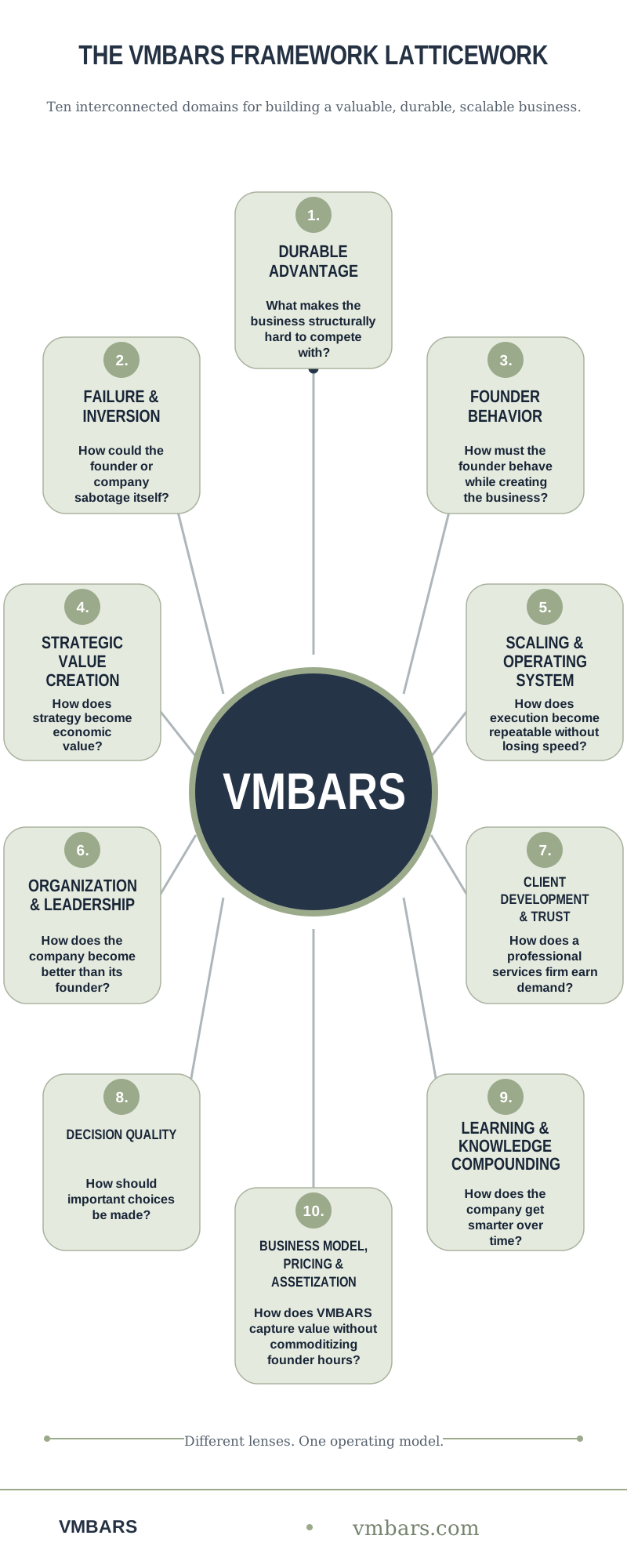
Durable Advantage: What would make the business structurally hard to compete with, not merely good at its work?
Failure & Inversion: How could the founder or company sabotage itself?
Founder Behavior: How must the founder behave while creating that advantage?
Strategic Value Creation: How do strategic choices translate into economic value?
Scaling & Operating System: How does execution become repeatable without losing speed?
Organization & Leadership: How does quality stop depending on founder heroics?
Client Development & Trust: How does expertise and reputation become trusted demand?
Decision Quality: How should consequential choices be made under uncertainty and incentives?
Learning & Knowledge Compounding: How does every project, decision, conversation, and failure make the company smarter?
Business Model, Pricing & Assetization: How does the business capture value and build leverage without commoditizing the judgment clients actually value?
The interesting part is where the frameworks collide
Founder intensity × institutionalization. The obsession that creates an early advantage can become the bottleneck that prevents the company from scaling. Recent founder-CEO research captures the tension well: founders can bring unusual vision and adaptability while underinvesting in operational governance or struggling to release control. The question is not whether founder intensity is good or bad. It is when a strength changes sign.
Trust × sales velocity. Professional-services clients are often buying judgment they cannot fully evaluate in advance. More pursuit is not always more effective. Sometimes the commercially rational move is to contribute value, learn, and wait for readiness rather than force the next stage.
Mission × profitable opportunity. Ellis offers a harder test of values: whether a firm will decline profitable work that conflicts with its principles. Mission therefore becomes a decision rule for client selection and growth, not language for an About page.
Assetization × bespoke judgment. Turning repeated work into IP, tools, data, templates, or products can create leverage. Productize too early, however, and you can freeze weak assumptions or commoditize the judgment that created the value.
Knowledge × execution. Reading and collecting frameworks can make a company smarter. It can also become intellectual procrastination. Tiago Forte's knowledge-management work repeatedly emphasizes that tools and notes matter only inside a workflow and that information becomes knowledge when it is put to use. That is the standard here: knowledge compounds only when it changes a decision, improves a process, sharpens a diagnostic, produces better evidence, or creates something reusable.
What the work has already changed
The framework did not begin as an attempt to invent intellectual property. It emerged because repeated work kept leaving behind reusable structure. A transition project produced artifacts that could support future role definition, interviewing, onboarding, and accountability. A sales conversation produced a diagnostic protocol. A commercialization exercise produced a reusable sprint with evidence standards, decision gates, and assetization rules.
A one-off deliverable creates value once. A reusable diagnostic, protocol, template, proof standard, or decision rule can improve the next engagement. The hypothesis behind the Latticework is that VMBARS can deliberately compound those lessons across services, intellectual property, media, and future products without pretending every bespoke problem is the same.
The counterexample is equally important. We have also seen how easy it is to create more frameworks, content packages, and ideas than the operating system can actually publish, test, or use. A knowledge asset that never changes a decision or reaches practice is not compounding. It is inventory.
Frameworks as hypotheses, not doctrine
The operating rule is simple: a framework enters the system because it answers a real question, supplies a useful mechanism, creates a productive tension, or suggests something we can test.
The goal is not to accumulate intellectual furniture. The goal is to make better decisions and then let evidence revise the model.
That means the Latticework should change. Some ideas will survive. Some will become protocols. Some will contradict one another in ways that are useful. Some will fail when they meet actual clients, collaborators, economics, or execution constraints.
Building VMBARS in public changes the standard
Publishing the Latticework creates a useful constraint: we have to distinguish what the literature says, what VMBARS is synthesizing, what we currently believe, and what we have actually observed. Those are not the same thing.
The public series will therefore do more than summarize books. Each essay will take one question, tension, protocol, or field result and examine what it means in practice. The framework is the map. The work is the test.
The first test
One example is relationship development. Traditional funnels tend to ask how to move a person toward our desired outcome. Our current hypothesis is different: every interaction should earn the next appropriate interaction, which may be a client opportunity, collaboration, referral, introduction, learning relationship, or simply stronger trust.
That hypothesis now has an operating protocol. The next step is to test it against real interactions and see what the evidence changes.
What I am trying to learn
Can VMBARS deliberately compound strategy, trust, operating discipline, intellectual property, media, and learning without becoming a collection of management slogans?
I do not know yet. Some parts of the model are established ideas borrowed from better thinkers. Some are VMBARS synthesis. Some are working hypotheses. Some now have early operating evidence. The point of the Latticework is to keep those categories visible and let practice decide what deserves to survive.
This series will document the attempt: what the models clarify, where they collide, what VMBARS changes in practice, and what the evidence eventually proves wrong.
The Latticework is a living system. As VMBARS tests these ideas in real work, later essays will document what holds, what changes, and what fails. Explore the series at vmbars.com.
Selected sources for this opening essay
- Charlie Munger, “A Lesson on Elementary, Worldly Wisdom” (1994), later collected in Poor Charlie's Almanack.
- Noam Wasserman, The Founder's Dilemmas: Anticipating and Avoiding the Pitfalls That Can Sink a Startup (Princeton University Press, 2012).
- Charles D. Ellis, What It Takes: Seven Secrets of Success from the World's Greatest Professional Firms (Wiley, 2013).
- Tom McMakin and Doug Fletcher, How Clients Buy: A Practical Guide to Business Development for Consulting and Professional Services (Wiley, 2018).
- Daniel Priestley, 24 Assets: Create a Digital, Scalable, Valuable and Fun Business That Will Thrive in a Fast Changing World (Rethink Press, 2017).
- Tiago Forte, “How To Take Smart Notes” (Forte Labs, 2020; updated 2022).
- Samantha Hellauer, Sanja Kos, Julie Vermoote, and BJ Wright, “The Strengths and Weaknesses That Set Founders Apart” (Harvard Business Review, October 21, 2024).